
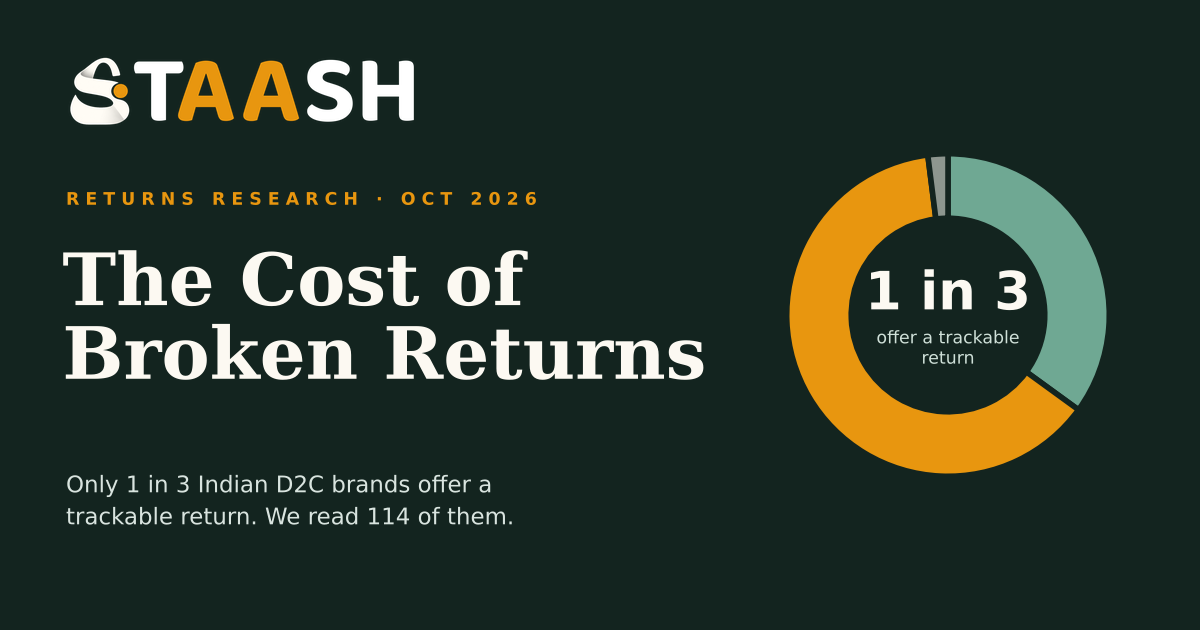
The Cost of Broken Returns
Most Indian D2C beauty and fashion brands still make you email a human to send something back. We read the fine print on 88 of them. Here is what a broken return policy is quietly costing them.
Ask any founder what their store is great at and they will talk about the product, the packaging, the unboxing. Ask them what happens when a customer wants to send something back, and the answer is usually a pause — followed by some version of "they WhatsApp us."
Returns are the part of the funnel nobody designs. And in a category built on fit, shade, drape and feel — beauty, fashion, lifestyle — the return is not an edge case. It is the moment a first-time buyer decides whether there will be a second order. We wanted to know how Indian D2C brands actually handle it, so we read the policies instead of guessing.
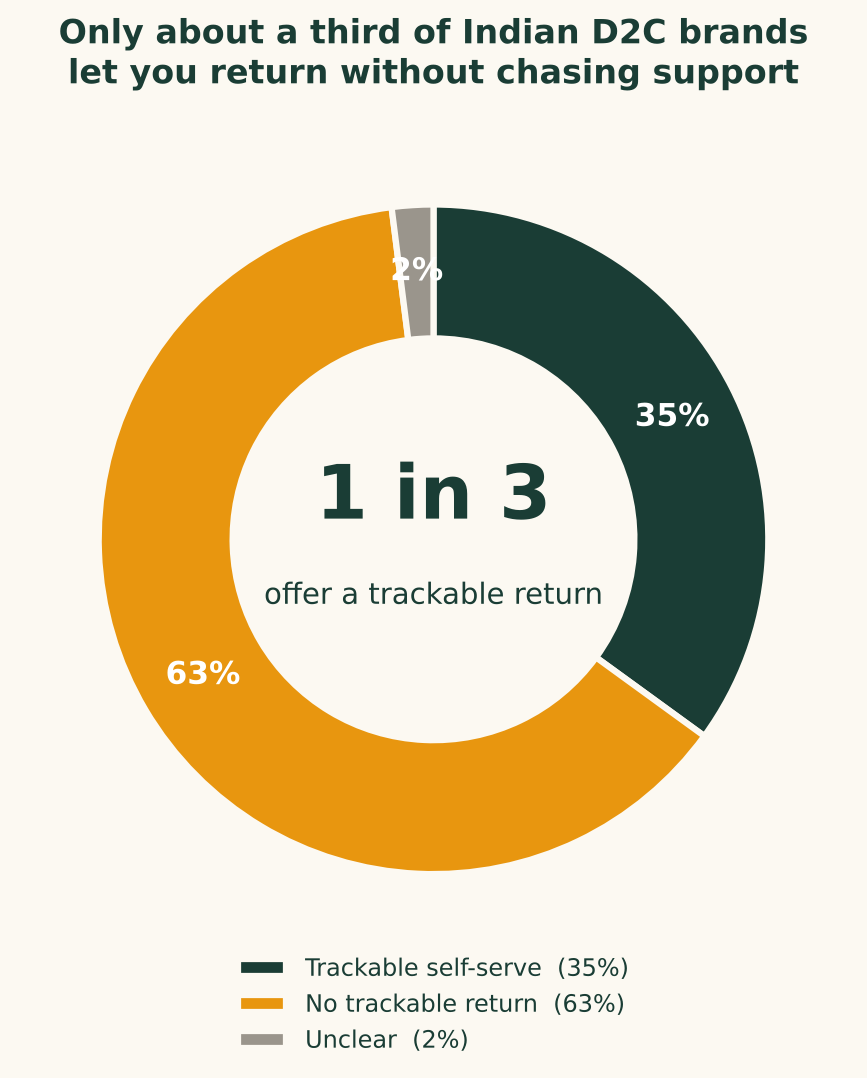
Only about a third let you return without chasing someone
A "trackable, self-serve return" means what every marketplace has trained the Indian shopper to expect: you log in, pick the item, print or scan a label, hand it over, and watch the status update until the refund lands. No email thread. No waiting for a reply.
Just 35% of the brands we could read offer that. A further 55% route you back to a human — and until that human replies, the customer has no label, no pickup, and no idea where their money is.
The default return channel is still an inbox
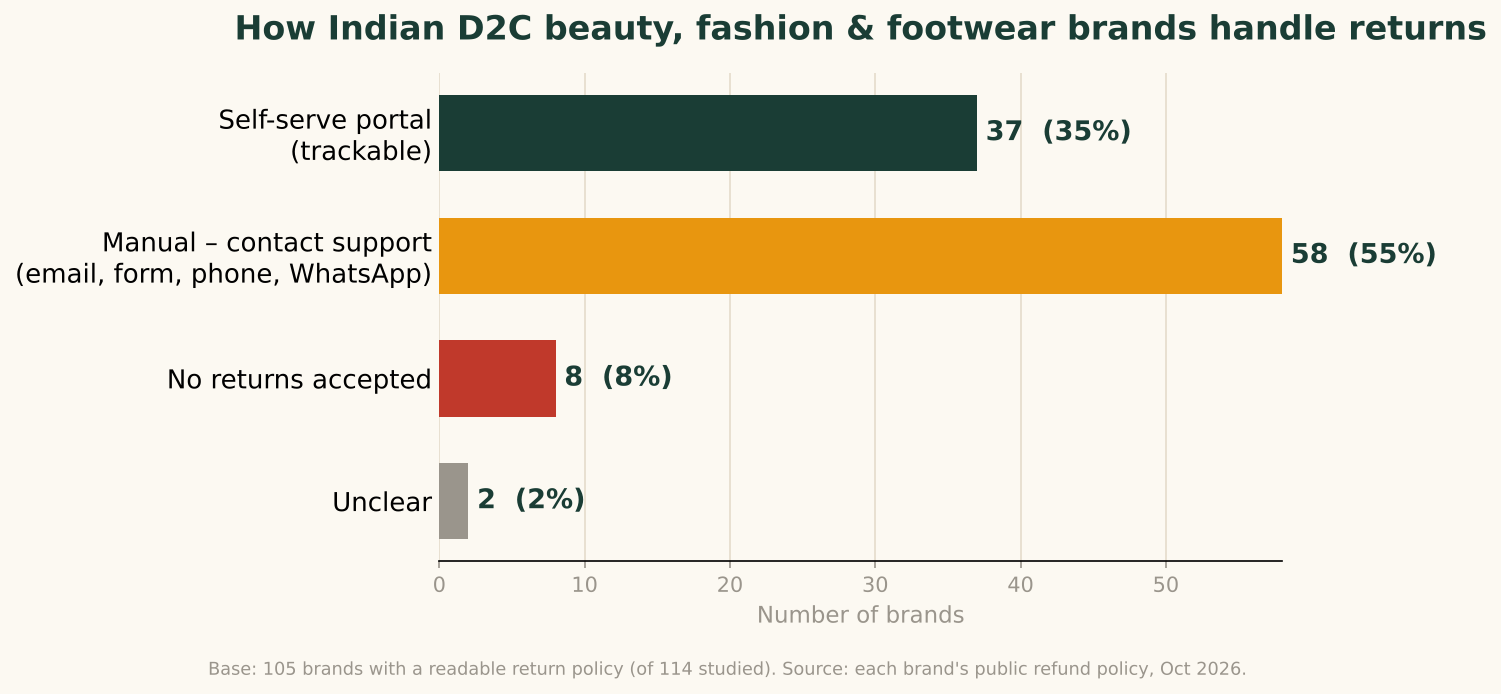
When we sorted brands by how a return actually starts, the single largest group wasn't "no returns" or "self-serve portal." It was manual contact — email, a web form, phone or WhatsApp — a message a staff member has to open, read and act on by hand. At 55% of readable brands, that one channel is bigger than every other route put together.
A manual return feels free. It isn't. Every one of those emails is a support ticket, a back-and-forth about pickup, a manually generated label, a manual refund, and a manually updated spreadsheet. The cost is just spread thinly across a team that is already busy — which is exactly why it never shows up as a line item, and never gets fixed.
And 8% of brands take the shortcut: no returns at all. In a fit-and-feel category, that is not a policy. It is a decision to lose the customers for whom the first purchase didn't quite work — which, in apparel and beauty, is a lot of them.
A return policy that reads "contact customer care" is really saying: the burden of our returns is on you, and we would rather you didn't.
The brands that refuse returns still offer them — on the marketplace
Here is the part that should bother every D2C founder. A brand can say "no returns" on its own website and, at the same time, list the exact same catalogue on Amazon, Myntra or Nykaa — where a 7-to-10-day return is mandatory, with free pickup and live tracking, because the platform requires it to sell at all.
Among the no-return brands in our set, the most recognisable ones do exactly this: a leading ethnic-wear label, a venture-backed skincare brand, and a Kannauj attar house all sell through marketplaces that guarantee returns the brands won't offer directly.
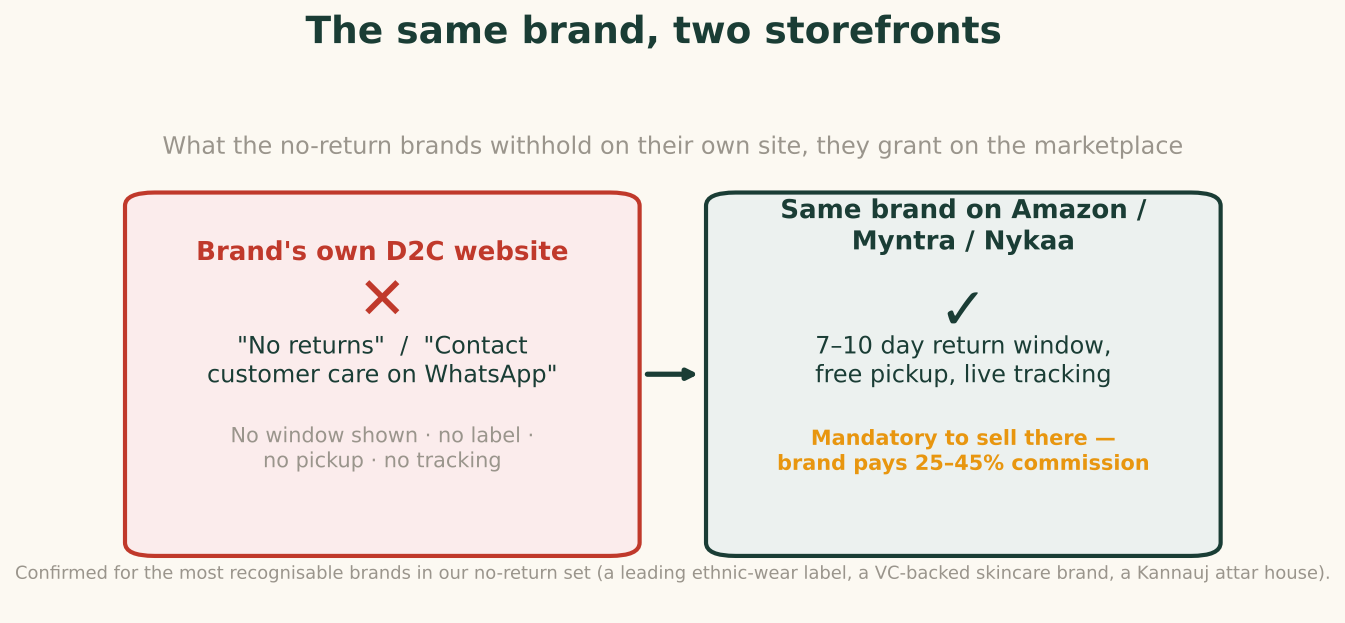
So the customer who wants a safety net simply buys the brand on the marketplace instead of the brand's own store. The brand gets the sale — minus 25–45% in marketplace commission, minus the customer relationship, minus the data. It is paying a platform a fortune to provide the one thing it could have offered on its own storefront for a fraction of the cost: a return the customer can trust.
Frictionless isn't the same as free
There's a reason the marketplace experience can't simply be copied wholesale. The same no-questions-asked return that wins a customer's trust also invites the opposite problem — ordering three sizes to keep one, wearing an outfit once and sending it back, returning on a whim. And the bill for that lands on the brand.
Every one of those returns is reverse shipping, inspection, repackaging and, often, a write-off. A policy that can't tell a genuine need from a casual one doesn't protect the customer — it quietly bleeds the brand offering it. So the answer isn't to hand shoppers a blank cheque to send anything back at any time.
The goal is a return that's effortless when a customer genuinely needs it, and checked when they don't. Easy to use. Hard to abuse.
That balance can't live in an inbox, and it shouldn't be rented from a marketplace. It belongs in one unified return policy the brand itself sets and controls — applied consistently to every order, available when it's genuinely needed, and able to say a reasoned no when it isn't.
Footwear leads on self-serve — but half still go manual
Because footwear carries the steepest return rates of all, we broke out the dedicated footwear and sneaker brands in the study and looked at them on their own.
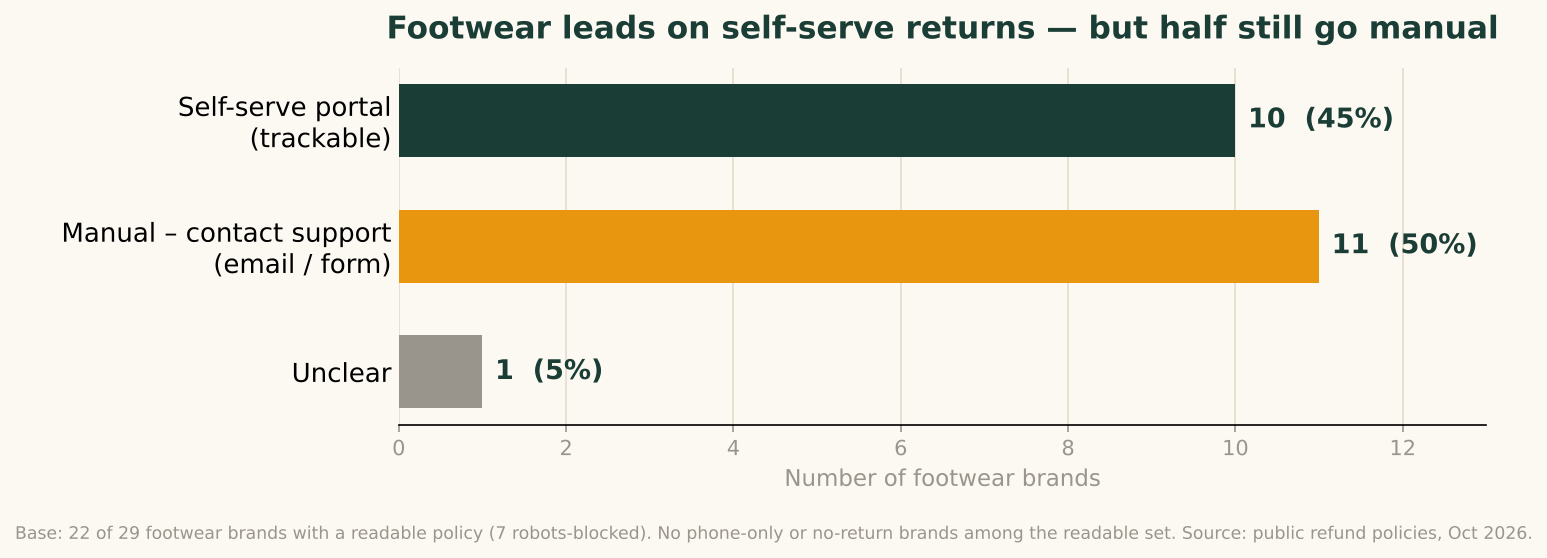
The good news: footwear leads the field. 45% of the readable footwear brands offer a trackable, self-serve return — comfortably ahead of the 35% study-wide average — usually through an off-the-shelf returns app. Sneaker brands in particular have worked out that a smooth return is part of the sell.
The catch is the other half. 50% still route returns back through an inbox — and for the one category customers are most likely to send back, every one of those is the most expensive kind of return to process.
And the law is about to make opacity a liability
This stops being a growth question and becomes a compliance one very soon. The Consumer Protection (E-Commerce) (Amendment) Rules, 2026 were notified in September 2026 and come into force on 1 January 2027. Among other things, they require product listings to carry detailed return and refund policies, and tighten disclosure and grievance-redressal obligations across sellers and platforms alike.
A vague "contact us to return" sitting in a policy page is exactly the kind of opacity the new rules are written against. The brands running clear, trackable, well-documented returns will be ready. The ones routing customers to an inbox will be scrambling — and explaining themselves to a consumer who now has the regulation on their side.
A return the customer can see is a return they trust
The fix isn't a bigger support team, and it isn't a free-for-all. It's one unified return policy the brand sets and controls — effortless when a return is genuine, and able to say a reasoned no when it isn't:
- Self-serve from the order. The customer starts the return themselves — no email, no waiting for a reply.
- Checked against one clear policy, a single published return window and policy shown on the product page and the policy page — consistent with what the new rules will require.
- Merchant approves or declines, with a reason. The brand reviews each request against that policy and either approves it, or declines it with a clear, valid reason the customer can see — never a silent no-reply.
- Pickup and label only once approved. The moment a return is approved, pickup is scheduled and a shipping label generated automatically; nothing goes back before it's cleared.
- Live status, so the customer always knows where their item and their refund are.
- A record of every return, so the brand can finally see what's coming back, why, and what it costs.
Done directly on the brand's own store — not rented from a marketplace — this turns the return from the scariest moment in the journey into a reason to buy again. It keeps the customer, the margin and the data where they belong.
That is the gap STAASH is building for: trackable, Shopify-native returns built on one unified policy the brand controls — the return experience shoppers already expect from the marketplaces, without the commission, without the compliance risk, and without handing customers a blank cheque to send anything back.
Returns, done right on your own store
STAASH is building trackable, policy-clear returns for Indian D2C brands — so you keep the customer, the margin and the data.
staash.in · Collaboratory Digital LLP, Bengaluru