Every Indian Direct-to-Consumer (D2C) founder has felt it: an order comes in, looks like a sale, and three days later it's back — undelivered, unopened, un-paid-for. Multiply that by hundreds of orders a month, and RTO (Return to Origin) quietly becomes one of the largest, least-discussed costs in the business.
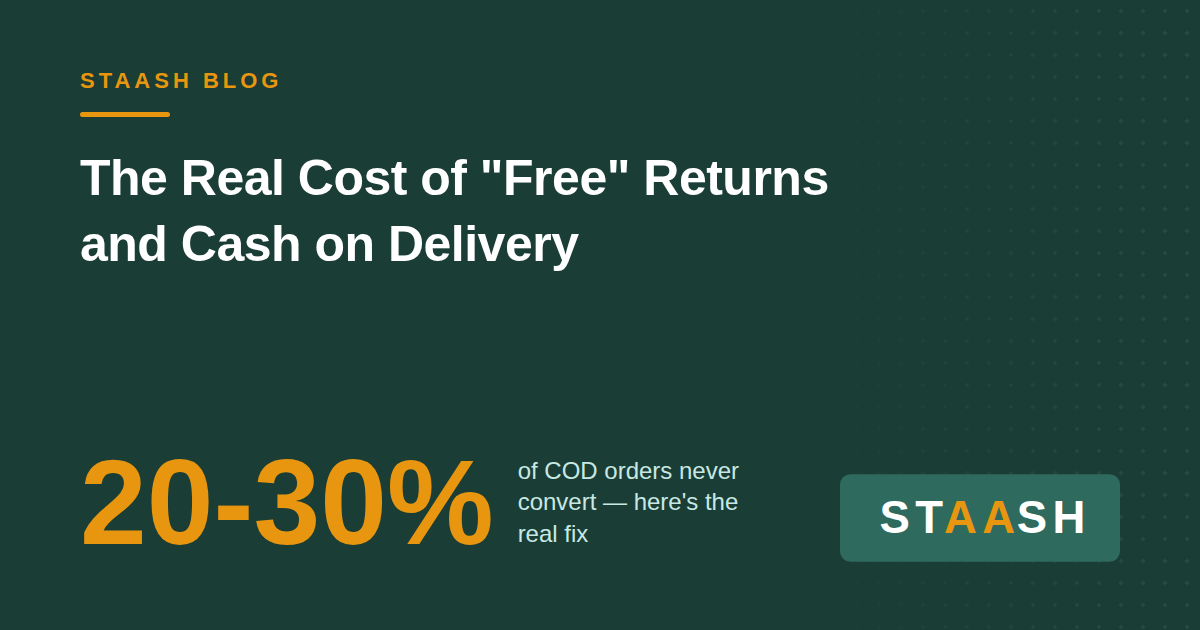
Industry estimates put Cash on Delivery (COD)-order RTO rates at 20-30% — meaning nearly a third of "sales" on COD orders never actually convert to revenue, after the brand has already paid for packaging, the first-mile pickup, and the outbound shipping leg. For a category already operating on thin margins, that's not a rounding error. It's often the difference between a brand that scales and one that quietly bleeds out.
Two different problems wearing one name
RTO gets talked about as a single issue, but it's really two, and they need different fixes.
The first is a courier problem. A delivery agent attempts a drop, can't reach the buyer, tries again, fails again, and on the third attempt, sends the package back. This has nothing to do with what the buyer intended to do — it's an execution failure in the last mile, and no amount of clever checkout design fixes a courier who couldn't get through.
The second is a commitment problem. COD makes ordering free of consequence. A shopper can add something to cart on impulse, without really deciding, because nothing is actually confirmed until a stranger is standing at the door with the product in hand. Some of those orders were never going to convert — the "purchase" happened at the click, not at any real decision point.
Conflating these two is why a lot of RTO "solutions" don't move the needle — they're aimed at the wrong half of the problem.
Why you can't just remove COD
The obvious-sounding fix — go cashless, make everyone pay upfront — doesn't survive contact with how Indian D2C shoppers actually behave. When we raised this directly with one of the founding brands on our own platform, the answer was blunt: some buyers genuinely need to pay in cash. Not everyone has seamless digital payment access, and for a meaningful share of shoppers, particularly outside metro cores, cash isn't a preference to be designed away — it's a real constraint.
More importantly, for a homegrown brand a shopper has never heard of, COD is also functioning as trust insurance. It's the mechanism that lets someone say "I'll try this small brand I found on Instagram" instead of walking away. Remove it entirely, and you don't just lose the cash-dependent shoppers — you lose a meaningful share of first-time buyers who needed that guarantee to take a chance on an unfamiliar name at all.
So the real question isn't "how do we get rid of COD." It's: how many COD orders are actually about cash, and how many are just about trust — and can trust be delivered a different way?
The fix that already exists in the payment rails
This is where it gets interesting: the infrastructure to solve the trust half of this problem already exists in India's Unified Payments Interface (UPI) stack, and it's more mature than most D2C founders realize.
National Payments Corporation of India (NPCI)'s Single Block Multi Debit (SBMD) framework — now live via providers like Razorpay as "UPI Reserve Pay" — lets a buyer authorise a payment once at checkout, blocking the funds without charging them, and lets the actual debit happen later, tied to a real fulfilment event. No cash changes hands. No repeated authentication. The buyer isn't charged until the order is actually delivered — the exact same guarantee COD makes, minus the cash.
This isn't a hypothetical feature request. It's explicitly documented for multi-fulfilment scenarios — including, per Razorpay's own use cases, "partial fulfilment" when a multi-product cart has items resolving at different times. That's not a coincidence; it's precisely the shape of a modern D2C cart with items from more than one seller.
Where this actually gets solved — together, not alone
A pay-after-delivery model built this way does something a raw "remove COD" policy can't: it lets a brand offer the same trust guarantee shoppers currently get from cash, without the cash-handling cost, the reconciliation delay, or the anonymity that makes COD fraud and serial-return abuse so hard to catch.
But it only works responsibly if it's trust-gated, not universal. A brand with no delivery track record yet shouldn't carry the same RTO risk tolerance as one with a long history of clean fulfilment — which means this has to be built alongside a real trust signal, not switched on for everyone at once. That's the same STAASH Health track record that governs a brand's standing on the platform more broadly, not a separate system built just for this.
And the piece that matters most is the one no single brand, however well-run, can build alone: knowing which delivery zones are genuinely high-risk takes order volume that an individual homegrown brand will rarely see on its own. Pooled across many brands, that same data becomes a real, usable signal — one that can catch a likely-to-fail delivery before it's dispatched, rather than after the third failed attempt.
COD isn't the enemy here. It's solving a real problem — for the people who genuinely need it. The opportunity is building a second path, for everyone who was only ever using COD as insurance, that keeps the guarantee and drops the cost.