Why Competitors Cluster — And Why the Same Principle Works Online
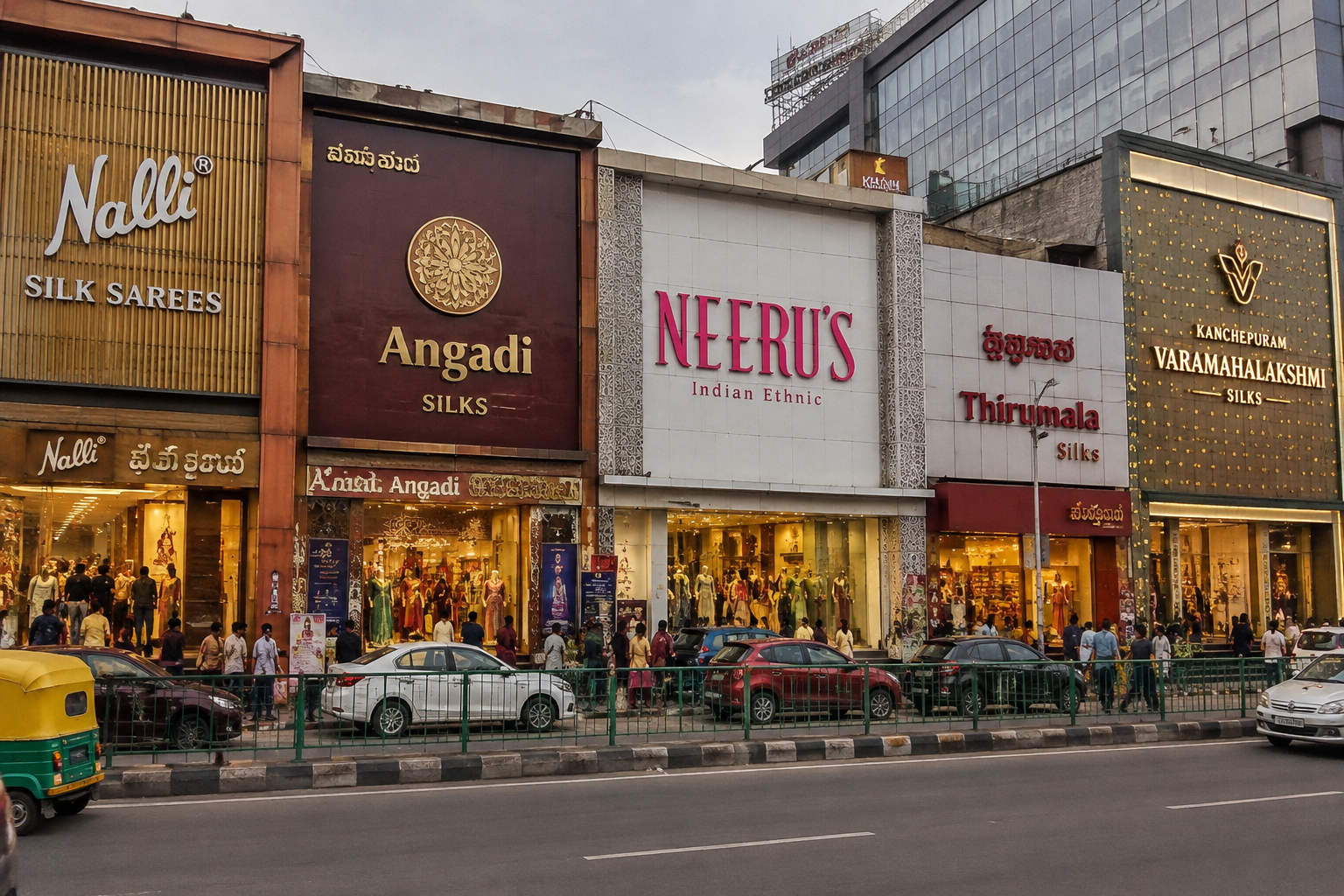
Walk down Jayanagar 33rd Cross, Marenahalli Road or Chickpet in Bengaluru and you'll notice something interesting.
There are businesses selling very similar products, often right next to each other.
Jewellery: 33rd Cross, Jayanagar
Silk Sarees: Marenahalli Road, Jayanagar
Multiple Categories: Chickpet, Bengaluru
At first glance, it seems like bad business.
Why would a store deliberately open next to a competitor?
Because the competition isn't the whole story.
The destination is bigger than any one store
A shopper doesn't necessarily visit a saree market despite there being dozens of saree shops.
They visit because there are dozens.
The concentration of stores creates a destination.
A customer looking for a silk saree knows that a particular street gives them choice. They can compare designs, prices, quality and brands without travelling across the city.
Each individual store competes for the customer's purchase.
But collectively, the stores create something none of them could create as easily on their own:
A reason for the customer to come there.
This phenomenon is known as retail agglomeration.
Research on retail agglomerations such as high streets and shopping centres has found that competition and cooperation between stores can improve the performance of the overall agglomeration. The benefits generated by the agglomeration can also spill over to individual stores, offsetting some of the negative effects of competition.
But doesn't competition reduce each store's share?
It can.
That's the important nuance.
If ten stores sell exactly the same product to exactly the same customer, competition can become destructive.
But most successful retail clusters aren't built that way.
Stores differentiate themselves through brand, assortment, price, quality, experience, service and positioning.
A customer may enter the cluster looking for a silk saree and eventually choose one particular store.
The other stores haven't necessarily created a loss for that store.
They helped create the reason for the customer to visit the cluster in the first place.
Competition can create the destination.
The same principle applies online
For a long time, retail agglomeration was thought of primarily as a physical phenomenon.
But the underlying economics doesn't require physical proximity.
Online, the equivalent of physical proximity is being on the same platform.
Researchers have specifically studied this.
In Shopping Malls, Platforms and Consumer Search, economists Alexei Parakhonyak and Maria Titova model marketplaces that include both physical shopping malls and online platforms.
Their research finds that consumers tend to start their search at larger marketplaces. Interestingly, despite greater competition, firms in larger marketplaces can earn higher profits. Under certain conditions, firms have an incentive to cluster in one marketplace because consumers face search costs between marketplaces but can compare sellers relatively easily within one.
That leads to a simple but powerful insight:
More choice can make the destination more attractive.
And a more attractive destination can create more opportunities for the businesses inside it.
Online agglomeration is not just a theory
Another study takes the idea even further.
In Segmentation versus Agglomeration: Competition between Platforms with Competitive Sellers, published in the Journal of Political Economy, Heiko Karle, Martin Peitz and Markus Reisinger examine what happens when competing sellers choose between platforms.
Their model shows that the outcome depends on how intense competition between sellers is.
When competition is extremely tough, sellers have an incentive to avoid competitors and spread across different platforms.
But when competition is softer, sellers can have an incentive to agglomerate on the same platform, while platforms compete to become the dominant destination.
This is an important distinction.
The lesson isn't:
"Put as many competing brands together as possible."
The lesson is:
"Create enough relevant choice to make the destination worth visiting, without making competition so intense that everyone becomes interchangeable."
That is where curation matters.
From shopping streets to digital platforms
Think about what happens when you visit a physical shopping cluster.
You may arrive looking for one particular product.
But once you're there, you discover other stores.
You compare.
You browse.
You find something you didn't know you wanted.
Online, the same behaviour can happen without physical distance.
Ten relevant brands can be one click apart.
A consumer looking for home décor can discover furniture, lighting, plants, textiles or accessories.
A consumer looking for a saree can discover multiple designers, styles and price points.
The brands compete.
But the collection creates something bigger than any one brand:
Choice.
And choice gives consumers a reason to start their search there.
This is particularly important for D2C brands
Most D2C brands have traditionally built their businesses around a simple model:
Run ads → bring traffic to your website → convert → repeat.
The challenge is that every brand has to continuously create its own destination.
Every brand has to fight for attention.
Every brand has to convince a consumer to discover it before it can sell to them.
For a small or emerging brand, this can be particularly difficult.
The brand may have a great product.
It may have great reviews.
It may have a strong story.
But if consumers don't know it exists, none of that matters.
What if brands could build the destination together?
This is where the idea becomes interesting for homegrown D2C brands.
Instead of every brand trying to create its own destination independently, what if relevant brands could collectively create a destination around consumer intent?
Not just:
"Here are 500 brands."
But:
"You're looking for this. Here are the best homegrown brands worth discovering."
That changes the role of the platform.
It isn't simply another place to list products.
It becomes a discovery destination.
This is the opportunity for STAASH
STAASH is built around this idea.
We want to bring India's homegrown D2C brands together around consumer discovery — giving shoppers a place to explore relevant brands, compare products and discover businesses they may never have encountered individually.
The objective isn't to eliminate competition.
It's to make the destination worth visiting.
And that distinction matters.
If LeafyAffair loses a customer to another brand on STAASH, that's real competition.
But the reverse is equally possible.
A customer who comes to STAASH looking for another brand may discover LeafyAffair.
The question therefore isn't simply:
"Will I lose some customers to another brand?"
The more important question is:
"Will being part of this destination help me reach customers I would otherwise never have reached?"
That's the same fundamental question that has played out on successful retail streets and in shopping centres for decades.
A digital retail cluster
Jayanagar's jewellery stores don't need every shopper to buy from every store.
Marenahalli Road's silk stores don't need to eliminate competition.
Chickpet doesn't work because every shop sells something completely different.
They work because consumers know:
"If I'm looking for this, this is where I should go."
STAASH wants to create the digital equivalent for India's homegrown D2C brands.
A place where consumers come not because there is only one brand to choose from, but because there are many relevant brands worth discovering.
And when the destination becomes stronger, the opportunity for the brands within it can become stronger too.
Competition doesn't always simply split the market.
Sometimes, competition helps create the destination that grows the market.
That's the power of retail agglomeration.
And online, we're only beginning to see what that can mean for D2C commerce.
Research behind the idea
1. Parakhonyak, A. & Titova, M. (2018). "Shopping Malls, Platforms and Consumer Search."
International Journal of Industrial Organization, Volume 58, pp. 183–213.
The paper examines differentiated sellers located in marketplaces such as shopping malls and online platforms. It finds that consumers can prefer larger marketplaces as starting points for search, and that firms in larger marketplaces can earn higher profits despite greater competition.
Read the paper — Oxford Research Archive
2. Karle, H., Peitz, M. & Reisinger, M. (2020). "Segmentation versus Agglomeration: Competition between Platforms with Competitive Sellers."
Journal of Political Economy, Volume 128, Issue 6, pp. 2329–2374.
The paper examines competing sellers and platforms and shows that the degree of seller competition affects whether sellers prefer to avoid competitors across different platforms or agglomerate on a single platform.
Read the paper — University of Chicago Press
3. Teller, C., Alexander, A. & Floh, A. (2016). "The Impact of Competition and Cooperation on the Performance of a Retail Agglomeration and Its Stores."
Industrial Marketing Management, Volume 52, pp. 6–17.
Based on research across three urban retail agglomerations and 277 store managers, the study examines how competition and cooperation affect both the performance of the overall agglomeration and individual stores.